


“Ah, this feels refreshing.”
My daughter said this as we stepped out of the building.
“Looks like it rained. The ground is wet.”
The mornings had been chilly for the past few days, so I’d come out wearing a mask.
“Oh, the weather’s nice today. Not much wind either.”
I thought it might be good weather for a round of par-three golf with my husband tomorrow. I got into the car and took off my mask.
“Isn’t it funny? This parking spot used to make the car hot in summer. Now it feels nice.”
“It’s warm.”
We laughed and drove off.
As I approached the apartment exit to turn right, an elderly woman stood still near the road. I almost stopped, then decided to keep going.
She could go first, but maybe she’d rather wait.
There were fallen leaves scattered beneath the trees along the road.
At the intersection, I stopped to wait for the left-turn signal.
“Haaaaah.”
“What’s wrong?” my daughter asked.
“Oh, I wasn’t sighing. I just felt so relaxed that the sound came out.”
“Ohhh.”
“Come to think of it, I’ve gotten pretty good at making sounds.”
I laughed, remembering something that had happened about a month earlier.
A Chuseok Morning
It was around 9:30 on the morning of Chuseok, the Korean harvest holiday, when my parents-in-law and my husband’s younger sister arrived at our home for the ancestral memorial ceremony.
Until we moved to Seoul seven years ago, we’d always hosted the family gathering at Chuseok. Relatives would come for the ceremony and eat together. Some of them would take food home.
I used to prepare enough food for nearly thirty people, almost entirely by myself. I would stay up most of the night cooking.
My mother-in-law was in poor health. After seeing her help with the cooking and then become so exhausted that she could barely get up, I told her I’d take care of everything myself.
And that’s what I did for nearly ten years.
After we moved to Seoul, we held a simple ceremony with just the five of us, while the relatives began observing the holiday in their own homes.
When we returned to Daegu after five and a half years in Seoul, my husband, as the eldest son, naturally settled the matter.
There was no need to change an arrangement that had already been working.
So only his parents came to our home for the ceremony. His younger sister, who lived with them about thirty minutes away, drove them over.
I had much less food to prepare than before, but I still got only three hours of sleep the night before.
I had planned to make two kinds of vegetable pancakes, one with napa cabbage and another with garlic chives. But my mother-in-law told me to make just one, so I chose the easier napa cabbage pancakes.
I bought just three large sweet potatoes and made jeon with them.
“That’s all?”
My husband laughed when he saw them.
In the past, I’d made three times as many, so we could enjoy some beforehand and pack some for the relatives to take home. This time, I wanted to reduce my workload.
I used to buy 1,200 grams of ground pork for the little meat patties we call donggeurangttaeng. This time, I bought just 400 grams and mixed it with squeezed tofu and finely chopped vegetables.
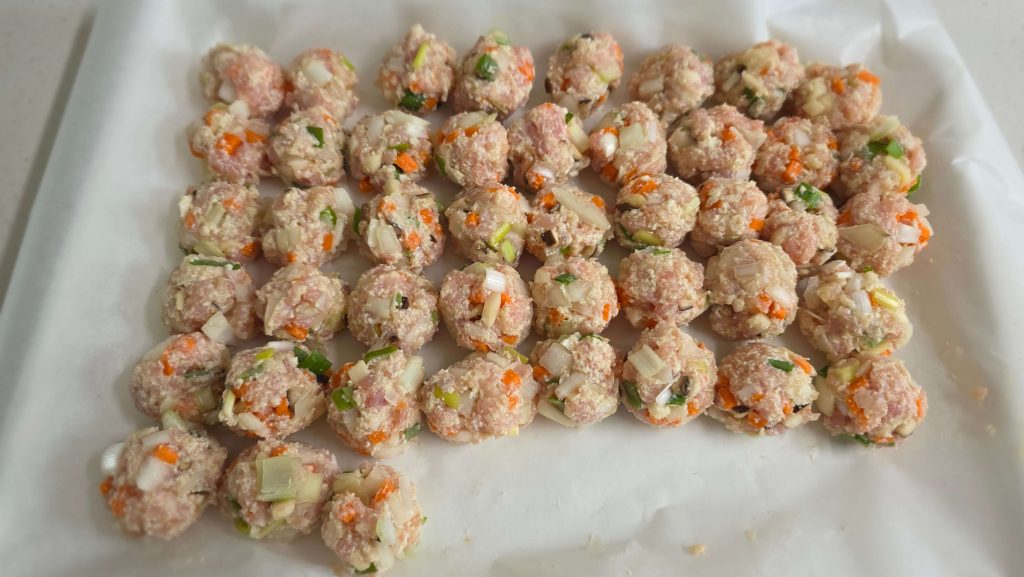
But I made the same amount of pollock jeon as before, using two fish. It was relatively easy to make, and I thought one fish wouldn’t be enough.
I also made the same amount of tofu jeon. All I had to do was slice a block of tofu and pan-fry the pieces.
I grilled yellow croaker and flounder, prepared five kinds of seasoned vegetables—bean sprouts, radish, bracken, bellflower root, and spinach—and made the traditional soup for the ceremony.
I also boiled octopus, steamed pork, and cooked braised beef short ribs.
“Darling, couldn’t I have just one little piece?”
My husband asked with a smile as I was frying the jeon that evening.
“Well, we’re supposed to wait until after the ceremony. But I’ll give you one of each.”
I laughed and put a meat patty and a piece each of sweet potato jeon and pollock jeon on a plate.
He sat at the dining table and ate them with such obvious pleasure that I found him rather cute.
“I could give you another piece of pollock. Want one?”
“No, that’s okay. It’s delicious. I just wanted to see how everything tasted.”
Of course, I’d already tasted a few pieces myself while cooking. Haha.
I’d told the kids beforehand that I wasn’t making huge quantities this year, so we’d save the food for after the ceremony. They didn’t even try to sneak a bite.
Compared with the enormous amount of jeon I used to make for the relatives, this was a much simpler holiday.
Still, arranging all the food neatly on the ceremonial dishes and setting the table took nearly an hour.
“Oh, you made so much!”
My parents-in-law smiled when they saw the table.
We bowed together, completed the ceremony, and sat down to eat.
Because both my parents-in-law had trouble with their knees, they ate at the dining table.
“Wow, this kimchi is excellent. You could open a kimchi shop!”
My father-in-law said as he enjoyed his meal.
“Do you still steam the pork over a layer of onions? We just boil ours, but it never tastes like this.”
My mother-in-law asked while dipping a piece of pork into the seasoned soybean paste.
“Yes. You’re the one who taught me how to do it. But the bottom of the pot gets scorched, so I have to scrub it afterward.”
“Cleaning the pot is the hard part. You didn’t need to make the beef ribs, though.”
“Your son said you both liked them, so he wanted me to make them.”
“The ribs are delicious too, but the pork was so good with the kimchi.”
My father-in-law smiled.
After serving my parents-in-law at the table, the rest of us sat on cushions on the living room floor, talking and eating together.
I’d made everything myself, and everything tasted wonderful.
“Uuugh.”
When I finished eating and got up to cut some fruit, a strange little groan escaped my mouth.
“That happens when you’ve been sitting on the floor and try to get up.”
My sister-in-law, who was still eating beside me, seemed to be explaining the sound on my behalf.
Oddly enough, I felt fine when I was standing. But whenever I got up from sitting or bent down to pick something up, a little groan would sometimes come out.
Oh dear, am I getting old?
Or is my body just tired because I barely slept?
I’d never done this before. The sounds seemed to come out on their own.
After the meal, my parents-in-law prepared to leave. They said someone was coming to visit them at home.
“We should stop holding these ancestral ceremonies.”
My father-in-law said it loudly, with a faint smile I couldn’t quite read.
“When I die, you can use your authority to stop the ceremonies altogether.”
My mother-in-law said this to me almost in a whisper.
To reach the elevator, they had to go down a few steps. Both of them held on to the railing and carefully stepped backward down the stairs.
“You worked hard. Everything was delicious.”
My son said this as he massaged my shoulders while we stood in the parking lot, watching their car leave.
“Yeah. Maybe it’s because I made less this year, but everything really did taste good.”
We laughed and went back inside.
Later, my husband told me something.
“My sister said Dad was shocked yesterday when someone he knows told him they don’t hold Chuseok ceremonies anymore.”
“Oh, so that’s why he said that. I thought maybe he’d noticed the sounds I was making without realizing it and was worried I was having a hard time,” I said with a smile.
My father-in-law had always held strong beliefs about the importance of ancestral rites. But it seemed that he, too, was being influenced by the changes around him.
“So you’ve started making sounds now,” my son said with a grin.
“Yeah. They just come out before I know it.”
We laughed together.
What I Never Said
Apparently, the sound I’d made while waiting at the traffic light had been quite noticeable. My daughter had immediately asked what was wrong.
Come to think of it, I hadn’t been in the habit of making sounds like that. Perhaps she’d assumed something must have happened.
A few months earlier, she’d asked me something.
“Mom, why don’t you ever talk about how hard things are for you?”
“Oh, I don’t really want to talk to you about those things. My mother used to tell me a lot about her difficulties, and I listened. But I don’t think it was particularly good for me. I talk to Dad.”
“Oh, I see.”
It was just a brief conversation that passed between us.
But even though I’d told her that, I realized I hadn’t really talked much about my difficulties with my husband either.
I’d simply gone about doing what needed to be done.
For nearly ten years, twice a year, at Chuseok and Lunar New Year, I’d stayed up most of the night preparing enormous amounts of food for the ancestral ceremonies.
And I never said, “That was hard.”
Instead, I heard people say, “You did a wonderful job,” or “You worked so hard,” and I felt satisfied with what I’d accomplished.
After all, it was only twice a year. I could certainly manage that much.
At some point, though, I just kept going.
I didn’t know whether I myself thought it was too much work, whether my parents-in-law realized how much I was doing, or what my husband thought about any of it.
I simply continued.
Then, gradually, I began to feel that my role and responsibilities had become fixed. What I did was taken for granted, and more requests and expectations seemed to be added on top.
Something about that didn’t feel right anymore.
So I began looking at what was actually my responsibility and concentrating on doing that part well.
When my husband was younger, he worked as a journalist and was busy day and night. There were quite a few things I took care of on his behalf.
Now he’s older and working as an online journalist, but he has enough time to take care of things for his parents himself.
Yet I’d continued doing some of those things exactly as before.
I hadn’t stopped doing my part. I’d simply stopped doing the things that weren’t mine to do.
And somehow, everything seemed to be finding its own place.
Ah, maybe that’s why I used to raise my voice.
Every year or two, I would find myself pouring out my pent-up feelings to my husband. Then tears would start flowing, and I’d end up shouting, almost as if I were screaming.
It was as though something that had been tightly blocked inside me suddenly burst out.
Looking back, the things that triggered those moments weren’t necessarily that serious.
But when I suddenly shouted, my husband would usually respond with something like,
“If you do that again, I won’t put up with it either.”
And because I’d been the one to raise my voice first, I always ended up apologizing first.
Haha.
What I Used to Put Up With
I think I was simply very good at enduring things.
Perhaps I’d been that way from the beginning.
Not long after I got married, I thought I might be pregnant.
Around that time, fluid started coming out of one of my ears, so I went to an ENT clinic.
I told the doctor I didn’t want to take medication because I might be pregnant.
He warned me that the treatment would hurt, then treated the inside of my ear directly over several days.
It was painful, but I sat still and let him do it.
“You’re tough!” he joked.
As it turned out, I wasn’t pregnant after all.
I remember thinking I’d gone through all that pain for nothing when I could simply have taken the medicine.
The funny thing is that my husband, who is nearly 190 centimeters tall and has a large build, doesn’t seem very good at tolerating pain.
Even when he has a slight cold, he’ll say his forehead feels hot and ask me to touch it to check whether he has a fever.
Years ago, after back surgery, he didn’t want to feel the pain when the anesthesia wore off, so he was given pain medication.
When I had COVID, I wore a mask and gloves, disinfected surfaces throughout the house, slept separately, and even cooked while wearing my mask and gloves.
I got through it without once complaining about how difficult it was.
No one else in the family caught it.
My husband seemed amazed by the way I handled everything.
But these days, I say things like this to him quite easily.
“I’m tired too, you know. I can’t do this anymore. It’s too much for me.”
Especially when he says something like,
“Can’t you just do it? You’re good at it anyway.”
It’s not so much that I don’t want to take responsibility anymore.
I’m genuinely tired.
Haha.
One day in the middle of summer, my husband and I went to play a round of par-three golf.
A group of four men behind us were talking loudly, apparently playing for money, and moving quickly from hole to hole.
My husband became uncomfortable and kept urging me to hurry.
“Don’t treat me like one of those men. They’ll probably just think I’m an older woman who isn’t very good at golf.”
I was actually the one reassuring my husband that everything was fine.
At one point, he suggested letting the group behind us play through.
A young couple playing ahead of us happened to overhear him. As they passed by, they told us we were playing at a perfectly normal pace and shouldn’t worry about it.
After that, I noticed that my husband had stopped worrying.
Another time, on the same nine-hole par-three course, I began moving ahead on my own around the seventh hole.
I’d finish my short approach shots and putting, then walk to the next hole without waiting for my husband.
He liked to practice several approach shots and putts before moving on.
“Why are you going ahead? Why don’t you wait for me?” he asked.
“Because I’m tired! If I use up all my energy now, I won’t even be able to hit the ball across the ravine on the last hole.”
“Oh, you’re tired.”
And he didn’t say anything more.
Haha.
The Sounds I Make Now
Ah, maybe letting these sounds out means things aren’t building up inside me anymore.
These days, I sometimes yawn loudly several times in a row.
My daughter finds it funny and laughs beside me.
One day, while my husband was driving and I was sitting beside him, I started yawning loudly, one after another. He laughed.
“Why are you laughing?” I asked.
“Because it’s funny hearing you go ‘Aaaah, aaaah, aaaah’ like that.”
We laughed together.
Oh, when was the last time I shouted at my husband like that?