

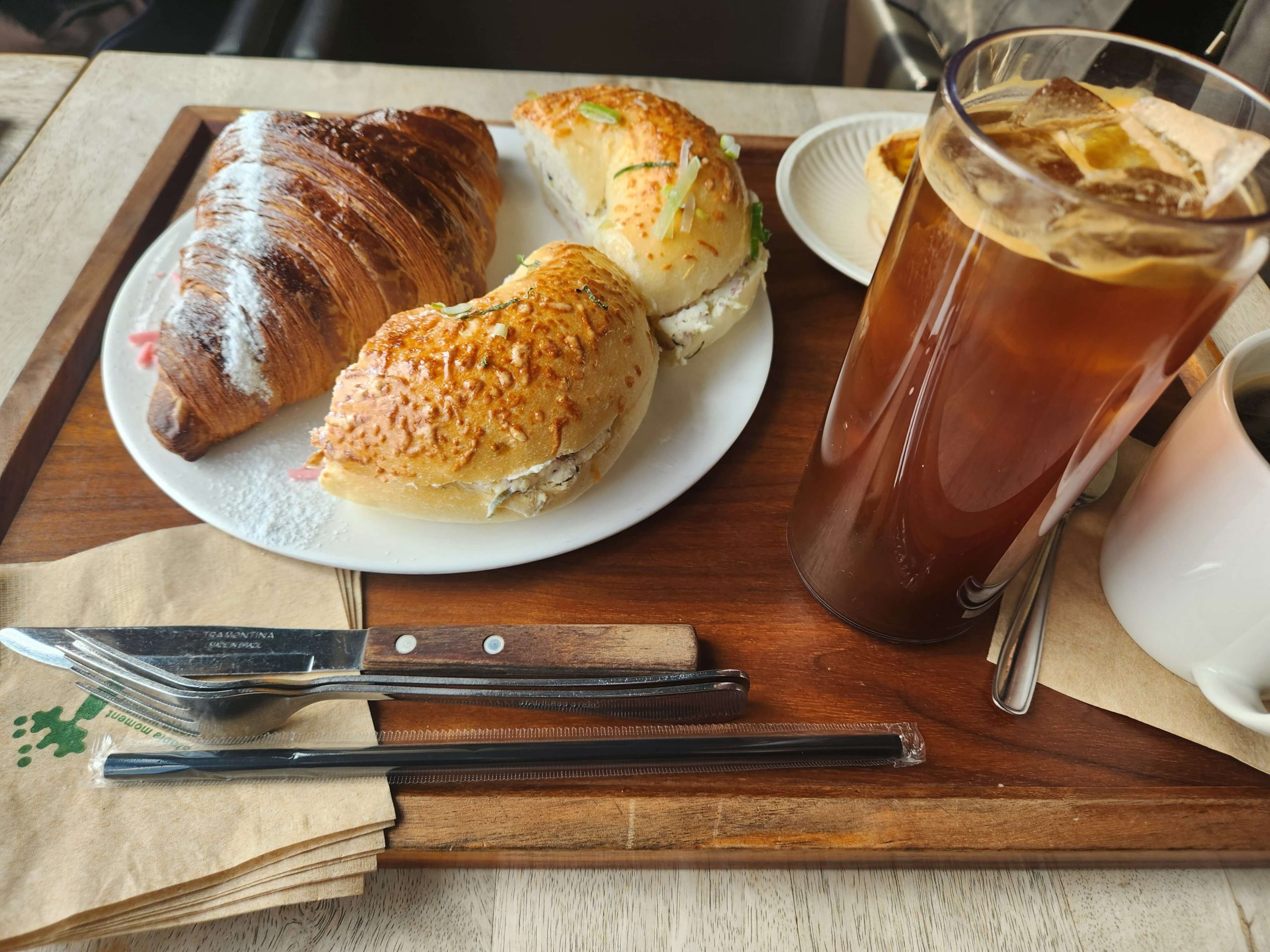
We Thought It Would Be Good
When my daughter and I went to a new café,
a large croissant caught my eye.
Next to it
were bagels filled with cream cheese.
They looked beautiful.
We placed them on our tray
without hesitation.
She ordered an iced Americano.
I ordered a hot one.
We found a seat
by the window
and took
our first bite.
Then,
almost at the same time,
we looked at each other.
“It’s too much.”
The croissant was covered
with powdered sugar.
The bagel was filled
with more cream cheese
than bread.
We both preferred
something simpler.
We tasted them,
smiled,
and quietly
left most of them behind.
Why Do We Get So Excited?
As I sat there,
I found myself wondering.
Why do we get excited
whenever we see
a croissant
or a bagel?
Why do we imagine
how good
it will taste
before we even
take a bite?
Maybe
it’s because
we don’t see them
every day.
Maybe
what feels special
often carries
a quiet feeling
of rarity.
Then Something Changed
Near my home,
there is a bakery café
that always sells
plain croissants
and plain bagels.
The kind
I actually like.
When it first opened,
I was delighted.
Sometimes,
I even asked
what time
the croissants would be ready.
I looked forward to seeing them.
The bagels
made me happy too.
There was a time
when I drove across town
just to buy one.
I even thought
about making them myself.
Now,
they are there
every single day.
And somehow,
I walk right past them.
I don’t even
look anymore.
Maybe This Is What Our Minds Do
The croissants didn’t become
less delicious.
The bagels didn’t become
less valuable.
They simply became
familiar.
And once
something becomes
part of everyday life,
our minds
quietly stop
treating it
as something special.
It fades
into the background.
Not because
it has lost its value.
But because
it is always there.
Mid-point
What becomes familiar quietly stops feeling special.
It Was Never Just Yogurt
Then I thought
about the yogurt
I make at home.
At first,
it was something fun.
Something special.
My husband loved it.
So I made it again.
And again.
Little by little,
it became
part of our routine.
One day,
the excitement
was gone.
The question became
simple.
“Do we have any yogurt?”
For a moment,
I wondered
how something
made with care
could become
so ordinary.
Then I looked at the croissants.
And the bagels.
And I understood.
A Simple Reset
Maybe
this is simply
what the human mind does.
Repeated gifts
quietly become
expectations.
Not because
people stop caring.
But because
what is always there
begins to feel like
it has always
belonged there.
Perhaps
the answer is not
to keep adding more.
Perhaps
a simple reset begins
when we pause long
enough to remember that
what feels ordinary today
was once
something
we were simply
happy to find.