

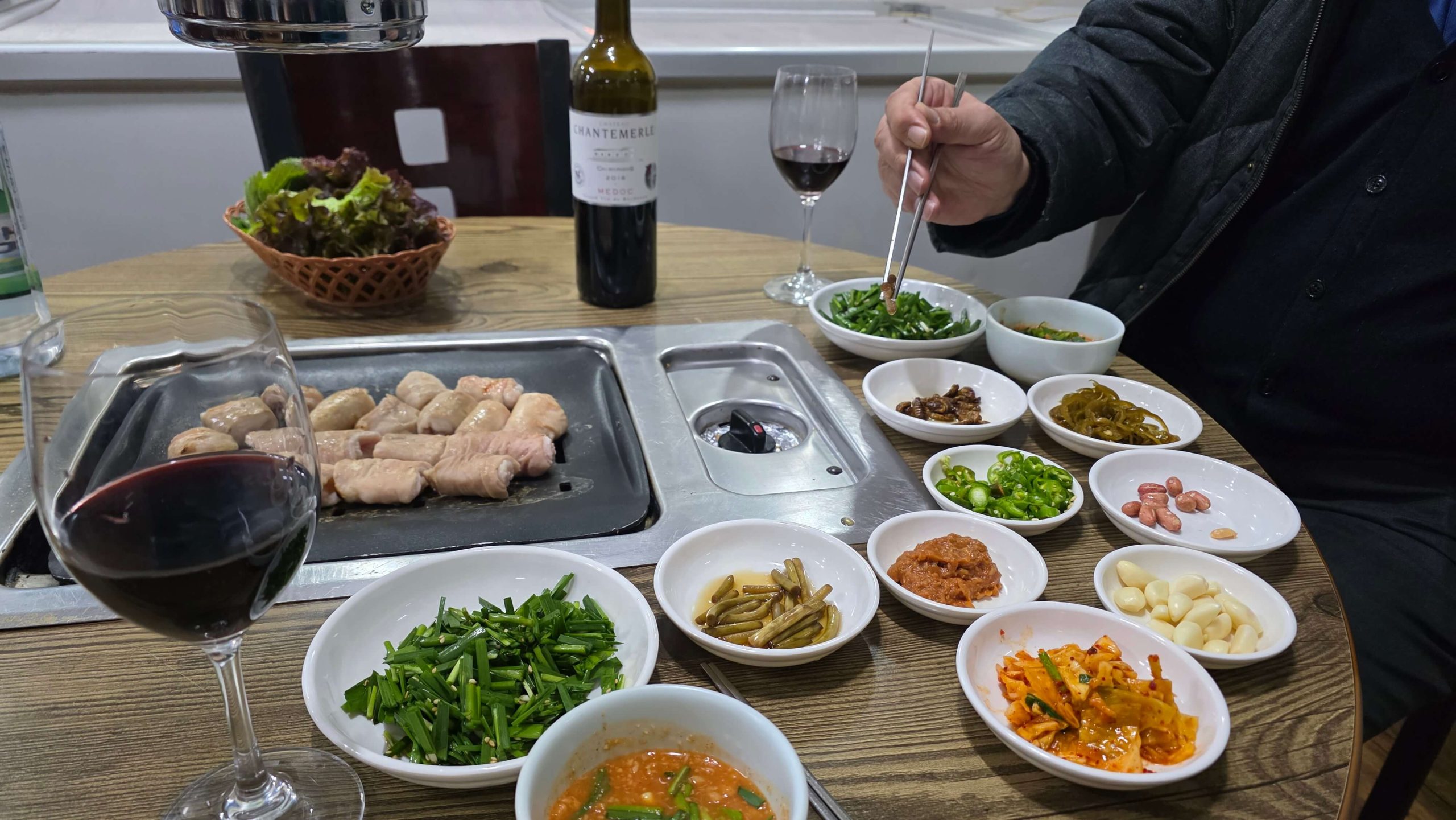
We used to eat out to enjoy ourselves.
Good food, a glass of wine,
a table filled with small dishes.
It felt like something to look forward to.
So I made sure I could enjoy it fully.
I took digestive enzymes before the meal,
ordered a little more than we needed,
and kept eating until the table was almost empty.
At the time,
I thought that was what enjoyment looked like.
But something always followed.
A quiet discomfort.
A heaviness I couldn’t ignore.
Sometimes, a long night I couldn’t rest through.
Still, I didn’t question it.
I thought
that was just the price of eating out.
Section 1 — The Way We Used to Eat
There was a night with my husband
that stayed with me longer than I expected.
We sat at a table filled with grilled pork,
small side dishes,
and a bottle of wine.
The heat from the grill,
the smell of food,
the quiet comfort of being out together.
It was supposed to be a good night.
And in many ways, it was.
We ate well.
We talked.
We drank.
But we didn’t stop.
I had already taken digestive enzymes
before the meal.
So I didn’t hesitate
when we ordered more.
Or when I kept eating
past the point of feeling full.
At some point,
I wasn’t tasting the food anymore.
I was just continuing.
That night,
my body responded in a way I could no longer ignore.
I woke up several times,
unable to rest.
Even after taking more enzymes,
the discomfort stayed.
It was not dramatic,
but it was clear.
Something wasn’t right.
Section 2 — A Different Table
A few days later,
I found myself in a hotel room with my daughter.
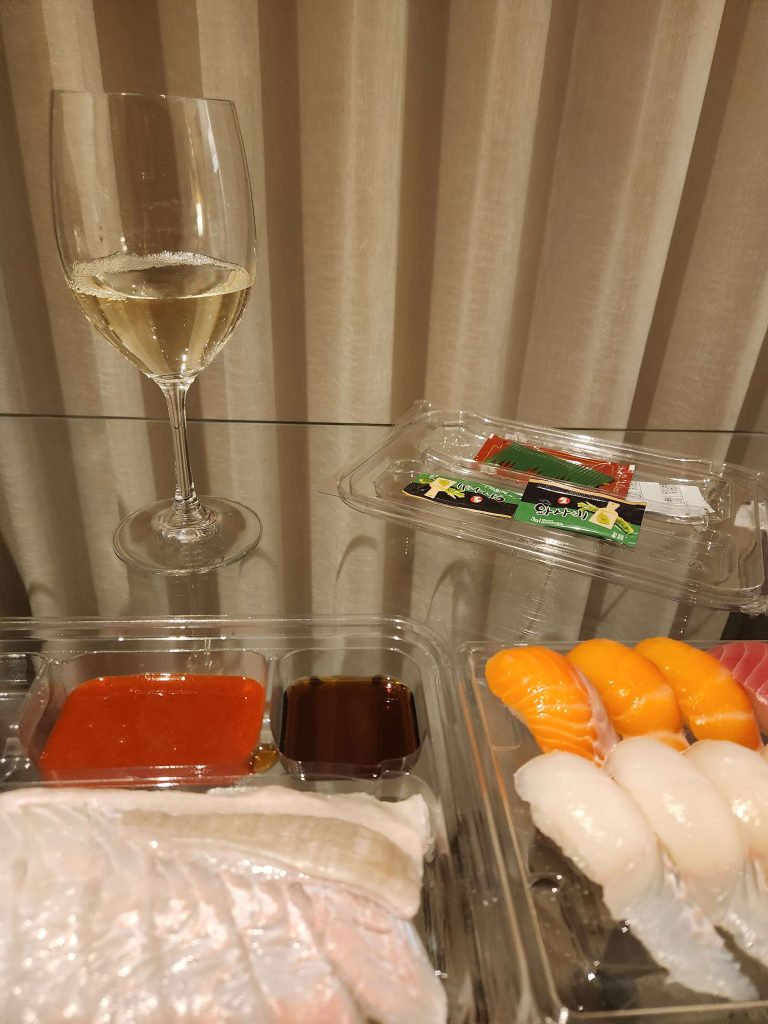
We had walked about ten minutes
to a large grocery store nearby.
We bought sliced fish,
a box of sushi,
a small piece of cheese,
and a bottle of white wine.
There were more expensive bottles,
but this one felt right.
It was less than five dollars.
We also bought a bag of ice
and carried everything back to the hotel.
Before we started,
we placed the wine in cold water
to bring the temperature down.
When we finally poured it,
it was light, clean,
and surprisingly well-matched with the fish.
I had once attended a long lunch in Italy,
with perfectly paired wines for every course.
But this felt better.
Simpler.
More balanced.
There was only one chair in the room.
I told my daughter to take it.
I sat at the edge of the bed,
sometimes standing.
At home,
I often eat this way too.
She told me to sit,
but I stayed where I was.
We began without a plan.
A piece of fish dipped in sauce.
A sip of wine.
Then a pause.
We ate slowly.
One bite at a time.
One sip at a time.
We didn’t try to keep a conversation going.
A few words here and there,
then silence again.
Not awkward.
Just quiet.
We poured small amounts of wine,
just enough to hold the glass lightly.
Twice was enough.
The rest stayed in the glass.
“Should we keep it?” she asked.
“It’s okay,” I said.
“We can leave it.”
And it felt completely natural.
Not wasteful.
Not careless.
Just… finished.
Afterward,
we went out for a short walk.
There was a small path near the hotel.
We walked slowly,
looked around,
then came back.
She went to bed.
I opened my laptop
and wrote for a while.
Then I slept.
Deeply.
Without interruption.
We stopped while it still felt good.
Section 3 — The Moment I Noticed
Something felt different.
Not in a big way.
Not in a dramatic shift.
But in the space between bites.
I stopped
before it became too much.
The wine stayed in the glass.
Part of the meal remained on the table.
And for the first time,
that didn’t feel like waste.
It felt like enough.
It wasn’t waste. It was enough.
Section 4 — What Changed
That was when I realized
it wasn’t about the food.
Nothing we ate that night was particularly special.
Not expensive.
Not complicated.
But something had changed.
I was no longer trying to get the most out of the meal.
I wasn’t trying to finish everything on the table.
I wasn’t even trying to feel full.
I was just… there.
Tasting.
Pausing.
Choosing.
Section 5 — The Habit of Eating More
We tend to eat quickly.
And we tend to eat more.
Especially when we eat out.
There’s a quiet thought underneath it.
Let’s enjoy this fully.
Let’s make it worth it.
So we order a little more.
We keep going a little longer.
Not because we are still hungry,
but because it feels like we should.
And over time,
that becomes a rhythm.
Restaurants serve more.
We eat more.
And without noticing,
our bodies begin to carry it.
Heavier meals.
Heavier feelings.
But we rarely question it.
We don’t eat more because we’re hungry.
We eat more because it feels like we should.
Because it looks like enjoyment.
Section 6 — Pause at the Table
I used to think pause belonged to certain moments.
A pause before reacting.
A pause in conversation.
But I hadn’t realized
it could exist here too.
At the table.
In the middle of a meal.
Between one bite
and the next.
Pause wasn’t about restriction.
It wasn’t about eating less
or being careful.
It was about knowing
when enough had already arrived.
Not at the end of the meal,
but somewhere in the middle—
when the food still tasted good,
and my body was still at ease.
I began to notice
it often came around the same point.
Not halfway.
Not at the end.
But somewhere around two-thirds.
Just before the taste changed.
When something that felt light
slowly started to feel heavy.
When something delicious
began to leave a dull aftertaste.
That was the moment
I used to pass without noticing.
Now I stop there.
There is one more thing I’ve learned.
Sometimes, stopping early means
leaving food on the table.
And at first,
that didn’t feel comfortable.
I felt a quiet sense of apology—
as if I had not appreciated the meal enough.
So when I return to a place I know,
I ask for less.
Not because I want to restrict myself,
but because I’ve learned
where enough is for me.
And somehow,
that feels more respectful—
both to my body
and to the food.
Closing
I used to think enjoying a meal
meant finishing it.
Now, I see it differently.
Enjoyment doesn’t come
from having more.
It comes from knowing
when to stop.
Not at the end—
but at the moment
when it still feels right.
When the taste is still clean.
When the body is still light.
I stop before I lose myself.
That’s where I stop now.
Not because I have to,
but because
it is already enough.
Enough doesn’t come at the end.
It arrives somewhere in the middle.